
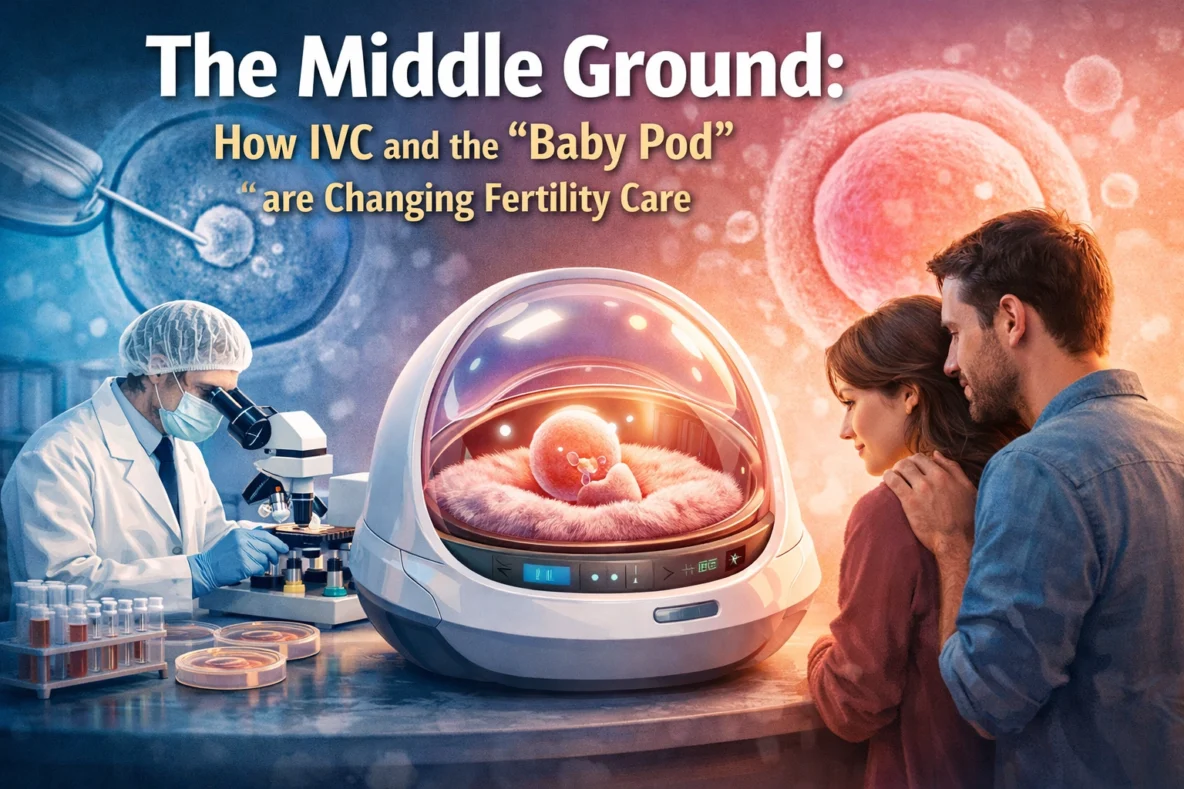
If you feel like fertility treatment options are “either/or,” you’re not imagining it. Many people are offered IUI (Intrauterine Insemination) on the lower-intervention end, or IVF (In Vitro Fertilization) on the higher-intervention end.
Bottom line: IntraVaginal Culture (IVC) is a middle-ground approach that uses an intravaginal incubation device (often nicknamed the “Baby Pod”) to support fertilization and early embryo development inside the body for a few days, instead of in a traditional lab incubator the entire time.
This post is purely educational—focused on the science, the step-by-step process, and who this option tends to fit (and who it doesn’t).
What Exactly Is IVC (IntraVaginal Culture)?
Bottom line: IVC is a method of fertilization and early embryo culture where eggs and sperm are placed into a small, sealed culture device that is then kept in the vagina for several days—so your body provides a stable “incubator-like” environment during the earliest stages of development.
Here’s the key difference from traditional IVF culture:
- In standard IVF, eggs are retrieved, inseminated (combined with sperm) in the lab, and embryos grow in a laboratory incubator with carefully controlled temperature, pH, and gas levels (usually oxygen and carbon dioxide).
- In IVC, fertilization and early embryo development happen inside a gas-permeable device (often the INVOcell, commonly nicknamed the “Baby Pod”) that stays intravaginally for about 3–5 days.
A helpful analogy: think of the device as a “tiny greenhouse,” and your body as the system that keeps the climate stable.

Meet the “Baby Pod”: What It Is (and What It Isn’t)
Bottom line: The “Baby Pod” is a small, sealed, gas-permeable culture capsule designed to hold eggs and sperm together while early embryos begin developing. It’s not implanted, and it doesn’t replace the uterus—its role is strictly early incubation.
People may hear different terms for the device. A common brand name is INVOcell, and many clinics/patients casually call it a “Baby Pod.”
What the device is doing biologically
Early embryo development needs a steady environment. In a lab incubator, temperature and pH are controlled by regulating heat and gas composition. With IVC, the device is engineered so that:
- Temperature stability comes from being inside the body (near core body temperature).
- Gas exchange happens through the device’s gas-permeable materials.
- The eggs, sperm, and developing embryos remain protected inside a closed system during the incubation period.
How it’s used (high-level steps)
- Egg retrieval: Eggs are collected from the ovaries (the same way they are in IVF).
- Loading the device: Eggs and prepared sperm are placed inside the capsule.
- Placement: The capsule is positioned in the vagina and typically held in place with a retention device (often similar in concept to a diaphragm).
- Incubation: You go about normal daily life for about 3–5 days while fertilization and early growth occur.
- Removal and assessment: The device is removed, and embryos are evaluated for development stage and appearance before the next step (transfer and/or freezing, depending on the plan).
For many people, the meaningful part is that the earliest days of development happen “closer to home,” while still using the core steps of IVF (retrieval, embryo assessment, and transfer).
Why IVC Exists: The “Middle-Ground” Logic (Benefits and Tradeoffs)
Bottom line: IVC aims to combine parts of IVF (egg retrieval, controlled insemination, embryo assessment, embryo transfer) with an alternative approach to the incubation phase—using the body’s environment instead of a lab incubator for the first few days.
Below are the commonly discussed reasons people consider IVC, with the important caveat that “best choice” depends on diagnosis, age, egg/sperm factors, and whether additional lab procedures are needed.
1) The incubation environment (what changes, scientifically)
The early embryo is sensitive to its environment. Traditional IVF incubators are designed to control:
- Temperature
- pH
- Gas composition (oxygen and carbon dioxide)
- Light exposure and handling
With IVC, the goal is to reduce external handling during those first days by keeping the culture device in a stable, body-temperature setting. The device still needs to be engineered for appropriate gas exchange—this is why “gas-permeable” design matters.
2) Lab intensity and logistics (why it may be simpler)
IVC can be structured with less reliance on continuous incubator-based culture during days 1–5. Depending on the protocol and clinic setup, this may reduce some lab workflow complexity during the early culture window.
3) Outcomes (what to understand before comparing)
Success is not one number—people mean different metrics:
- Fertilization rate (how many eggs fertilize)
- Blastocyst rate (how many reach day-5/6 stage)
- Implantation rate
- Clinical pregnancy rate
- Live birth rate
IVC can be a strong option for appropriately selected patients, but it’s not automatically “equal to IVF for everyone.” The limiting factor is often what else you need beyond incubation (for example, advanced sperm techniques or genetic testing).

The Step-by-Step Process: What Typically Happens in an IVC Cycle
Bottom line: IVC follows many of the same steps as IVF—medications, monitoring, egg retrieval, fertilization, embryo development, and embryo transfer—but the early culture phase happens in the intravaginal device.
A typical sequence looks like this:
- Ovarian stimulation (medications): You take fertility medications to help multiple follicles (egg-containing sacs) grow. The intensity can vary—some protocols are milder, others look similar to standard IVF.
- Monitoring: Ultrasounds and bloodwork track follicle growth and hormone levels so timing is precise.
- Trigger shot: A final medication dose helps mature the eggs and times ovulation so retrieval can occur before the eggs are released.
- Egg retrieval: Eggs are collected from the ovaries using ultrasound guidance (usually with sedation).
- Sperm preparation: A semen sample is processed to concentrate motile sperm and remove seminal fluid and debris.
- Loading the IVC device: Eggs and prepared sperm are placed into the capsule, which is then sealed.
- Intravaginal incubation (about 3–5 days): The device is placed in the vagina and kept there during early development. Many people can do normal daily activities with specific restrictions (your clinic will outline these).
- Device removal and embryo check: The device is removed and embryos are evaluated for development and quality.
- Next step: transfer and/or freezing: Depending on embryo stage and your treatment plan, an embryo may be transferred to the uterus, and additional viable embryos may be frozen (cryopreserved) for future use.
One important detail: embryo “grading” is largely based on appearance and development timing. It’s useful, but it’s not a guarantee—some average-looking embryos become healthy pregnancies, and some beautiful embryos do not implant.
Who Tends to Be a Good Candidate (and Who Usually Isn’t)
Bottom line: IVC can be a good fit when you need something more effective than IUI but may not need every advanced lab add-on used in conventional IVF. Candidacy depends on age, ovarian reserve, sperm factors, and whether extra embryo testing/handling is planned.
IVC may be considered when:
- You have a reasonable ovarian reserve (your clinician may discuss AMH, antral follicle count, and FSH as markers).
- You’re moving beyond IUI and want a step up in control over fertilization and embryo selection.
- Your sperm parameters are adequate for standard insemination (not always, but often).
- You prefer fewer days of embryo culture in a lab incubator.
IVC may be less suitable when:
- There is severe male factor infertility where ICSI (intracytoplasmic sperm injection) is recommended. (ICSI means a single sperm is injected directly into an egg.)
- You plan to do PGT-A/PGT-M (preimplantation genetic testing for aneuploidy / monogenic disease). These typically require embryo culture to the blastocyst stage and embryo biopsy, which is a more lab-intensive pathway.
- You have a history suggesting you may benefit from extended embryo culture, specialized embryo selection, or multiple lab procedures.
Actionable “what to ask for” (educational checklist)
If you’re comparing IUI vs IVC vs IVF, ask your fertility specialist for:
- AMH, day-3 FSH/E2, and antral follicle count (ovarian reserve basics)
- A semen analysis with motility and morphology (male-factor basics)
- A tubal and uterine evaluation (HSG/HyCoSy and/or saline sonogram)
- A clear plan for whether you would need ICSI or PGT and how that impacts your options
Common Questions (Straight Answers)
Does the pod fall out?
Usually, no. The device is typically held in place with a retention method (often similar in concept to a diaphragm). You can generally walk, sleep, and use the bathroom normally, but you’ll be given specific activity instructions.
Can I feel it?
Many people report they don’t feel it once it’s positioned, or it feels similar to having a tampon or diaphragm in place. Sensation varies.
Is IVC “IVF-Lite”?
Bottom line: It’s IVF-like in core steps (retrieval, insemination, embryo assessment, transfer) but different in where early culture happens. Whether it’s “lighter” depends on your protocol and what lab procedures you need (like ICSI or PGT).
How is fertilization confirmed if embryos are inside the device?
Fertilization is assessed after the device is removed and embryos are examined. This differs from standard IVF, where fertilization checks can happen in the lab the next day.
What are the main limitations of IVC?
The biggest limitations are usually the need for additional lab procedures (like ICSI or PGT) and the fact that embryo development is assessed at removal rather than through ongoing lab-based observation.
What should you do next if you’re researching IVC?
Bring your diagnosis and key test results to a fertility specialist and ask a very specific question:
- “Given my AMH/antral follicle count and semen analysis, am I a candidate for IVC, and would I still need ICSI or PGT?”
That single answer often clarifies whether IVC is truly a middle-ground option for you.