
![[HERO] Beyond the](https://cdn.marblism.com/0RqZ31WHtyA.webp)
When you begin the journey of In Vitro Fertilization (IVF), it’s easy to feel like you’ve entered a high-tech factory. You see the schedules, the medications, and the clinical waiting rooms. But here is the bottom line: Your fertility journey is not a sub-assembly line, and your embryos are not generic products.
In the world of reproductive medicine, there is a common practice often called “copy/paste” medicine. This is when a clinic applies the exact same stimulation protocol, the same lab conditions, and the same transfer timing to every single patient who walks through the door. While this might be efficient for the clinic’s bottom line, it ignores the fundamental biological truth that every patient and every embryo is unique.
At New Direction Fertility Centers, the philosophy is simple: one size does not fit all. Achieving high IVF success rates requires a shift away from administrative convenience toward a hyper-personalized lab environment.
The Problem with “Standard” Protocols
In a standard clinic, you might notice that everyone starts their medications on the same Monday of the month. This is often done to make scheduling easier for the staff. However, your body doesn’t care about a clinic’s administrative calendar.
When a protocol is standardized, the nuances of your hormonal profile are often overlooked. Personalized fertility treatment starts long before an egg is retrieved. It begins with understanding how your ovaries respond to “priming” (the phase before stimulation) and how your body metabolizes specific medications.
If a clinic uses a “copy/paste” approach for stimulation, they might miss the optimal window for egg maturity. By tailoring the dosage and the timing to your specific follicle growth, the lab receives eggs that are at their peak potential for fertilization.

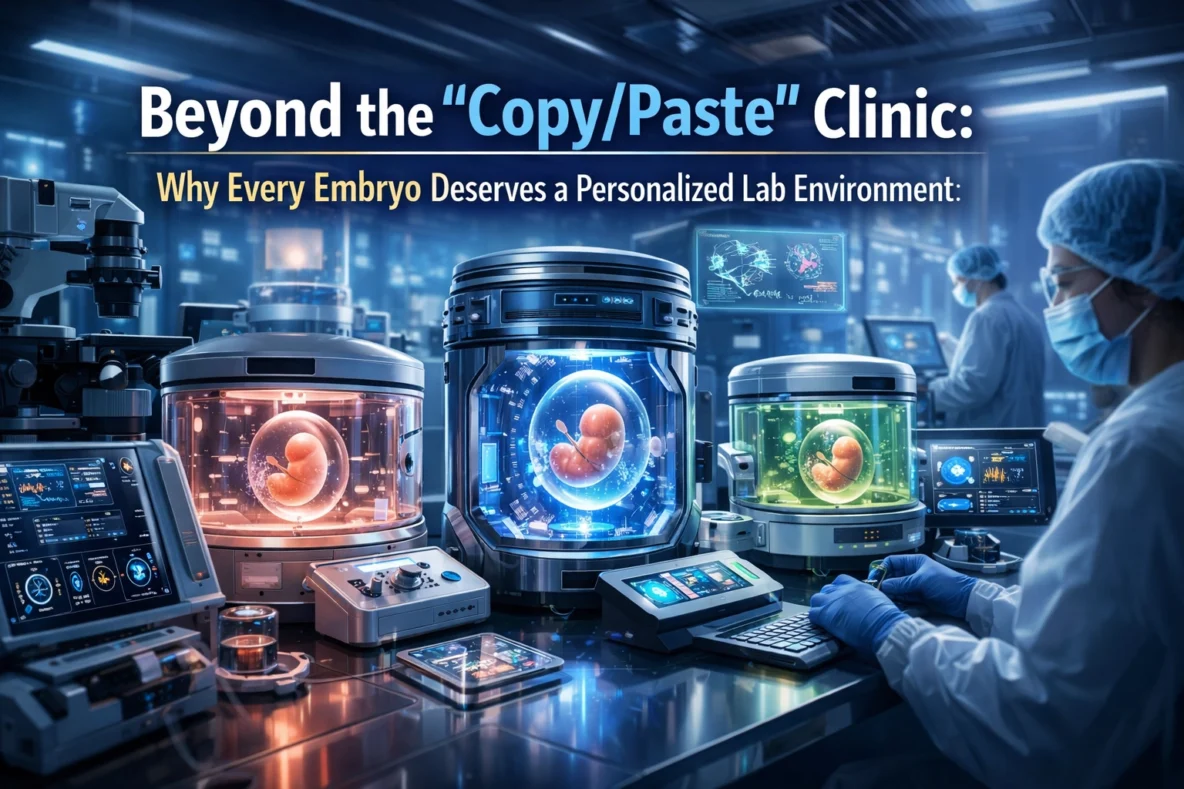
The “Private Suite” Experience: Astec EC10 Incubators
Once the eggs are retrieved and fertilized, they move into the lab. In many traditional labs, embryos are kept in large, communal incubators. Think of this like a large hotel floor with one giant door at the end of the hallway. Every time a scientist needs to check on one patient’s embryo, the door opens, and the “climate” for everyone’s embryos is disrupted.
Temperature and pH levels are the lifeblood of embryo development. Even a slight fluctuation caused by opening an incubator door can stress an embryo.
This is why individualized Astec EC10 incubators are a game-changer. Instead of a communal space, these act as “private suites” for your embryos.
- Zero Interference: Each patient has their own small, dedicated chamber.
- Rapid Recovery: Because the chamber is small, the environment (CO2, O2, and temperature) recovers almost instantly if it needs to be accessed.
- Stability: Your embryos are never affected by the work being done on someone else’s cycle.
By providing a stable, undisturbed environment, we allow the embryo to focus all its energy on cell division and growth, rather than recovering from environmental stress.
Why the Air Your Embryos Breathe Matters
We often talk about the liquid media embryos grow in, but we rarely talk about the air. Embryos are incredibly sensitive to Volatile Organic Compounds (VOCs). These are microscopic toxins found in everyday items, perfumes, cleaning supplies, or even the off-gassing of new furniture.
While a human adult has a liver and lungs to filter out toxins, an embryo consists of only a few cells. It has no defense mechanism. If the air quality in a lab is sub-par, embryo viability can plummet.
This is why LifeAire Air Filtration is a non-negotiable part of a high-tech lab. Standard HEPA filters (the kind you might have in your home) are not enough for an IVF lab. LifeAire is a multi-stage molecular purification system that removes 99.99% of biological and chemical contaminants.
By scrubbing the air to an ultra-pure state, we ensure that the only thing your embryos are interacting with is the specialized culture media designed to help them thrive. It’s about creating a “bubble” of safety that mimics the protected environment of the human womb as closely as possible.
Clarifying the “Batching” Confusion
You may have heard the term “batching” and felt a bit uneasy about it. In many clinics, “classical batching” is done for administrative convenience, everyone is forced into the same window so the doctors can take long breaks or manage staffing more easily.
At NDFC, we view batching through a different lens: the “Deep Clean” philosophy.
We organize cycles into specific blocks not for our convenience, but for the safety of the lab environment. Here is how it works:
- The Active Cycle: A group of patients moves through their retrieval and culture phase simultaneously.
- The Deep-Clean Week: After the embryos are safely transferred or cryopreserved (frozen), the entire lab is shut down for a dedicated “clean room” reset.
- The Result: This prevents the buildup of any potential contaminants or “lab fatigue.” It ensures that when the next group of patients begins, they are entering a lab that is at its absolute peak performance level.
This approach prioritizes the highest standards of safety and success over a constant, 365-day-a-year “factory” churn.
Personalizing the Final Step: The Transfer
The journey doesn’t end in the lab. The transfer process is the culmination of all that hard work. Just as the lab environment is tailored, the transfer itself must be personalized.
Some patients benefit from specific techniques like embryo glue to assist with implantation, while others may require a different hormonal support protocol following the transfer. We also look closely at the timing of the “implantation window.” Using a standardized calendar for every patient is one of the biggest reasons for failed transfers in “copy/paste” clinics.

FAQ: Understanding Personalized Lab Care
Q: Does every clinic use individualized incubators?
A: No. Many clinics still use large, box-style incubators. While these are common, they do not offer the same level of environmental stability as the Astec EC10 “private suites.”
Q: Is LifeAire really that different from regular air filters?
A: Yes. Regular filters catch dust and large particles. LifeAire uses UV light and molecular scrubbing to kill viruses and neutralize chemicals (VOCs) that are toxic to embryos.
Q: Why does my doctor want to “batch” my cycle?
A: You should always ask why. If it’s to allow for a lab deep-clean and sterilization, it’s a sign of a high-quality lab. If it’s just to fit a specific calendar date, it may be for administrative convenience.
Q: How do I know if my protocol is personalized?
A: Ask your provider how they determined your medication dosage. A personalized protocol should be based on your specific lab results (like AMH levels), your age, and your previous response to fertility medications: not a standard “starter kit.”
Taking the Next Step
If you are feeling overwhelmed by the technicalities of IVF, remember that you don’t need to be a scientist to advocate for your care. You deserve to know what is happening behind the closed doors of the lab.
When interviewing a fertility center, don’t be afraid to ask about their technology. Ask about their air filtration. Ask if your embryos will have their own “suite” or if they’ll be sharing a room with dozens of others.
The transition from “patient number” to “individual” is what changes the outcome. By focusing on the unique needs of every embryo, we move away from the “copy/paste” model and toward a future where every patient has the best possible chance at success.
For more information on the stages of IVF and what to expect during your journey, you can explore our User-Friendly Guide for Patients or browse our latest blog updates.
Your journey is unique. Your lab should be too.